How does one tackle the unknownness and sublimity of the future if we haven't gotten there yet? How will the future look different for each individual around the world and how will this affect the intricacies of various cultures and the environment on a global scale? Prof. Robb’s “On Definitions Primer” delves into the distinctions of descriptive (used to define a term) and prescriptive (how that term is used in certain situations) and when to use each descriptor based on the word being defined. In this case, the future could be defined using both as an attempt to understand such a vast concept of time.
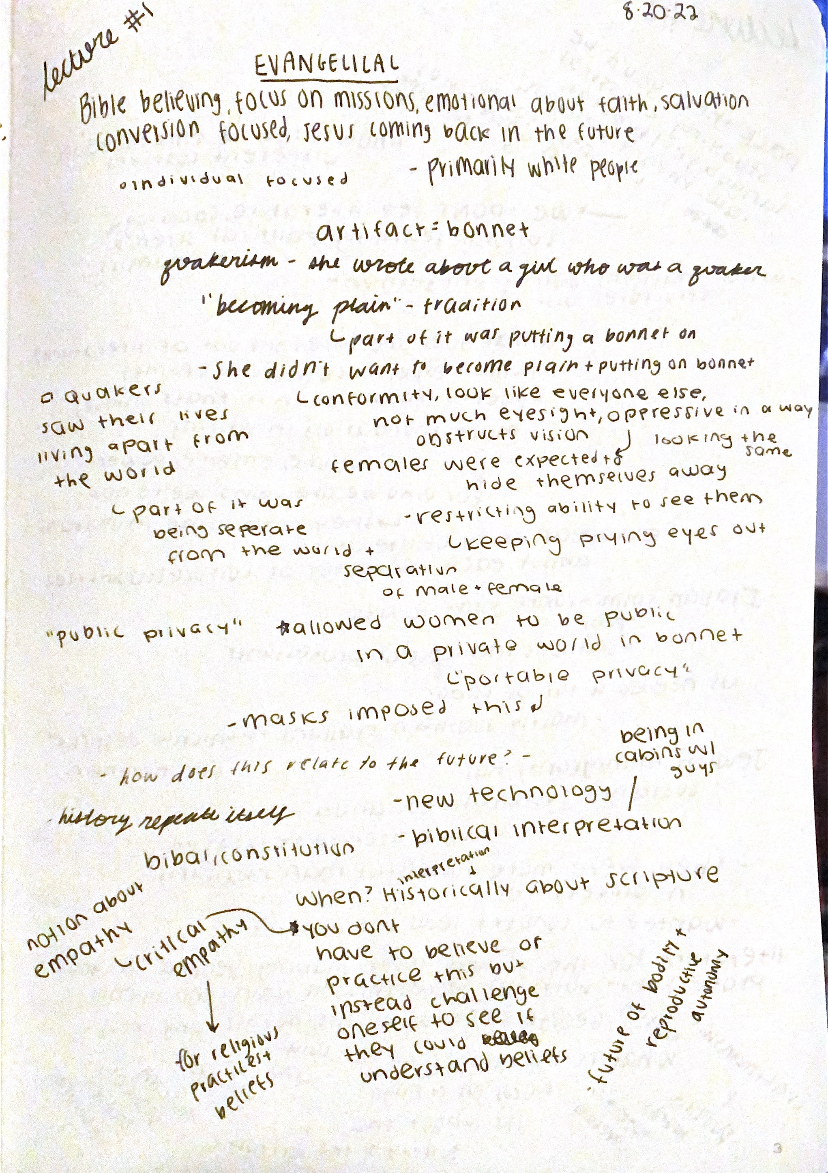
Starting with Sapere Aude, focusing specifically on three different lectures in relation to the units covered throughout the semester, the first perspective, from an evangelical point of view, defines the future as a focus on mission and emotionally connecting to the faith individually. The bonnet plays a big role in Quakerism as a form of “becoming plain” as a way of conforming to the religion. Although many groups of people around the world still abide by this tradition, its minimal use in more developed areas mark a new era not only in the evangelical community but also in many other religions, especially with the uprising of new technologies. Therefore, for the future, it's important to have a notion about empathy in that one doesn't have to believe or practice a certain religion but instead challenge oneself to see if they could understand beliefs. Similarly, in Unit 1, while reading The Garden of Forking Paths, by Jorge Luis Borges, On September 1st, 2022, we talked about how perception dictates our present, so in relation to religion as a whole, do we act under the illusion that we have free will in hope for a better future? Change, in a way, is implicit and when you start to think about why or when people or in this case, religions too, change over time, understanding this may make it more complicated. Thinking of the future having this in mind on a personal level, it's essential we develop a sense of our changing selves and embrace each obstacle and asset we are presented with.
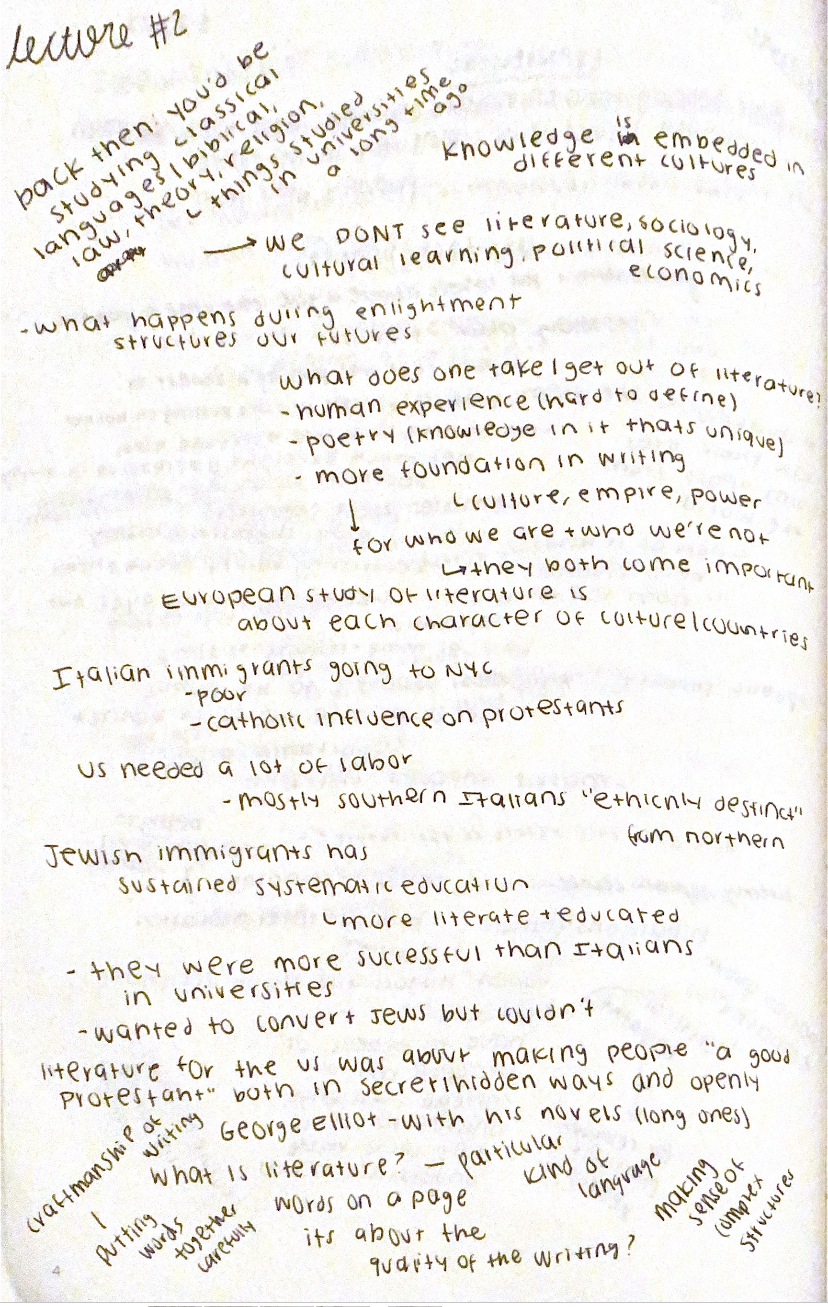
The next lecture defines the future in a prescriptive way (Robb), in that what happens during the enlightenment structures our futures. In the past, one would be strictly studying classical languages and biblical law, where one's interpretation of the future wasn’t based on the knowledge embedded in different cultures, like in the present, where we more often see literature, sociology, cultural learning, political science, and economics. As a result, one gets out the human experience, which is tough to define since it is unique to each individual. Having more foundation in writing helps one find who they are and aren’t going to be in the future. Nevertheless, these tools help not only for us to analyze our intentions with our future, but also tailor the ways in which we envision it. For example, in unit 1, In D.T. Niane’s Sundiata: An Epic of Old Mali, the griot, master in the art of eloquence, has the important deed of preserving mankind’s memories, which was passed down by his father’s extensive knowledge about the history of the tribes. He emphasizes the relevance of making an effort to remember and share the history of one’s ancestors. Most importantly, he has the power to pass down those memories and stories which are not only essential in keeping and maintaining the history of Mali, but in honoring it as well. In this case, he’s set his intentions with the future, defining it at the time that is still to come in successfully preserving the stories of his ancestors.
In addition, during a plenary session on December 1st, 2022 during Unit 3, we talked about pan-Africanism, how it's connected to a variety of cultural music and the people who promoted this music wished for an individualized experience. So connecting this idea to the future, we can define it from the perspective of how we use music to define our future. With the rise of technology and multiple ways of retrieving new music, many modern nuances of music will form, in which we will use as a collective to characterize and represent the sublimity of the effects of music in the future.
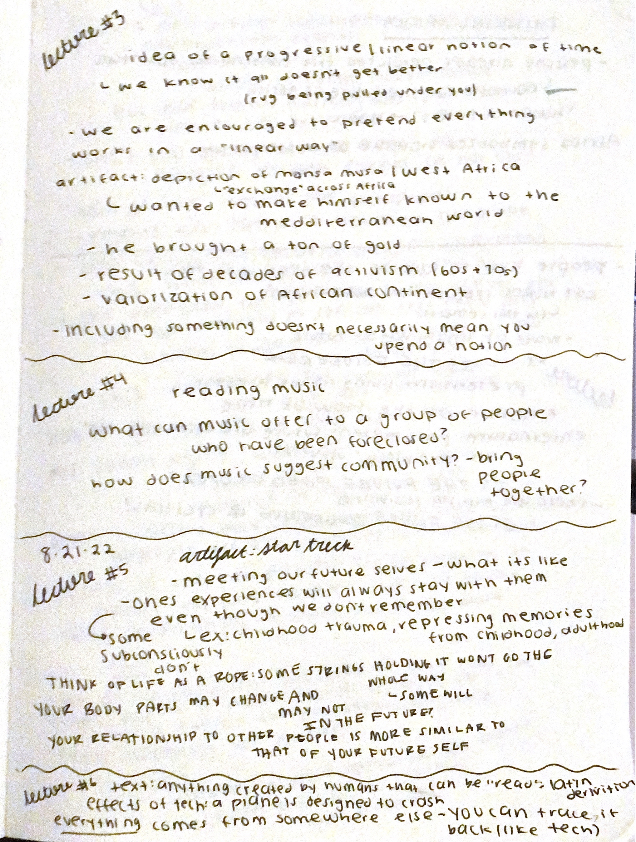
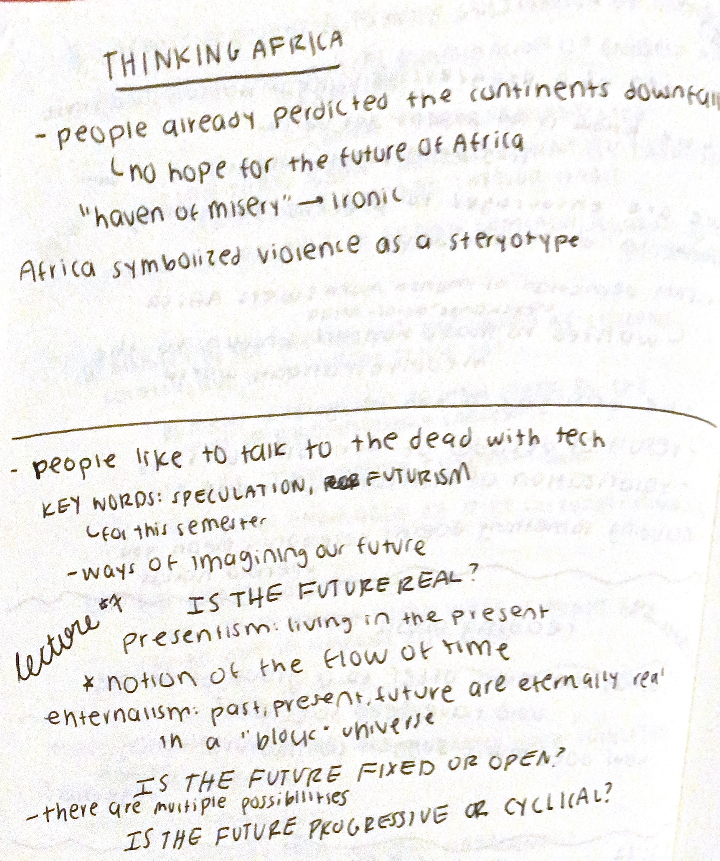
Similarly, in lecture 3, we talked about the idea of a progressive and linear notion of time as a way to define the future where we know it all doesn’t get better and are encouraged to pretend everything works in a “linear fashion”. Mansa Musa, for example, talked about both in pre-orientation and in unit’s 1 and 2 wanted to make himself known to the mediterranean world, so he brought a ton of gold which was talked about in detail when I watched Sun of the Soil (2019), a documentary about the layered sources of silence about Mansa Musa. So, how does this rarely-spoken about silence play a part in the future and define it? Using Mansa Musa as an example, it highlights people’s attempts in exploring and understanding this mysterious and powerful ruler. Towards the beginning of the film, one of the speakers mentions how many believe Africa’s “history begins in slavery”, which correlates to Troillot’s point in Silencing the Past about the dilemma of how Western scholars/ education depicts and classifies any other cultures/communities as not being intelligent since they didn't have as many manuscripts or books to source their knowledge from. When trying to find a manuscript mentioning Mansa Musa, the man working there explained how there was no such thing and how many could be hidden in caves or underground to protect them from being burnt by the colonists in the past. That is to say, the people who burnt those manuscripts in the past basically stripped the African’s of their identity and, in a way, made their history start during slavery. This is the version of history trying to be upheld by many archives which proves that the past goes hand in hand with the future in defining it. In addition, as discussed in plenary during unit 2 on September 29th, in order to have a vision for the future, you must have imagination of what it would mean to imagine this world that at times, just like in the case of Mansa Musa, may seem out of reach, therefore, our ability to imagine a world that is impossible feels impossible.
In Unit 4 on the aesthetics of the future, Dr. Pyle in plenary touched up on how the future is featured in this topic where we can look at the black body in different senses versus how it was previously perceived. We closely observed and attended the Jacobly Satterwhite’s exhibit “Finding Home Again” who defined his black body in many forms. Through immersive digital installations, he defined the black bodies of the individuals in the videos displayed centered around consumption, fantasy, labor, and sex. Satterwhite’s exhibition defined the future in his own way, by combining his past of playing video games with real and imagined people, places, and objects to create new worlds. The sublimity of interpretation carries on throughout his exhibit, as each one of the viewers, based on previous experiences, had different opinions, perceptions, and thoughts on the work. Therefore, the way in which we define the future is heavily influenced by the art we go to watch or see. It gives us a new perspective on how to interpret various works. In Unit 5, ethics of the future, specifically focusing on Memory Lane, the future of interpretation, with its sublime intricacies, will be up to the individual and society as a collective. How will we gather sources to create works of art in the future? Will it all be digitized? Our morals will change through time based on the ethics of what is right and wrong with the rise of new perspectives and occurrences. When writing Memory Lane, Natasha Tretheway talked to us about the amount of types of sources which include transcripts, photographs, court documents, notes, letters, records, and many more other sources unique to her. With a sublime amount of accounts for events, people, and memories through time, the future, in this case, is defined by the memoirs of our past and the tangible evidence of our existence. Lastly, in Unit 6, ends of the future, Wills talks about reproductive futures and how Roe vs. Wade affected the reproductive futures of women from the 1960s to now. In this case, when doing further analysis of the future, it is defined in this case by the constitution and the bible. While the Bible has a moral influence where people can take it with a grain of salt or live by it, one has to abide by the Constitution where there is this reverence for the originalist readers of the Constitution. Both, though, have much in common that have and continue to define the future of America, specifically. They are both an ancient read, without the need for repair. In both of these modes, the text controls the reader and guides them where the reader must submit to the text. In addition, there are multiple different ways to interpret them which in turn, creates new and more ways of implementing them in our interpretation of the future. Nevertheless, by taking these small, yet useful puzzle pieces from our past and history, we can use it to find recurring trends across time to have a better understanding of what our future holds for us.
___________________________________________________________________
Work Cited
“On Definitions, by Prof. Robb.” HumDavidson, https://web.archive.org/web/20210617120751/https://hum.davidson.edu/on-definitions-by-prof-robb/.
Notes from red notebook during pre orientation (lecture 1)Notes from red notebook during pre orientation (lecture 2)Notes from red notebook during pre orientation (lecture #3)Notes from red notebook: Thinking Africa