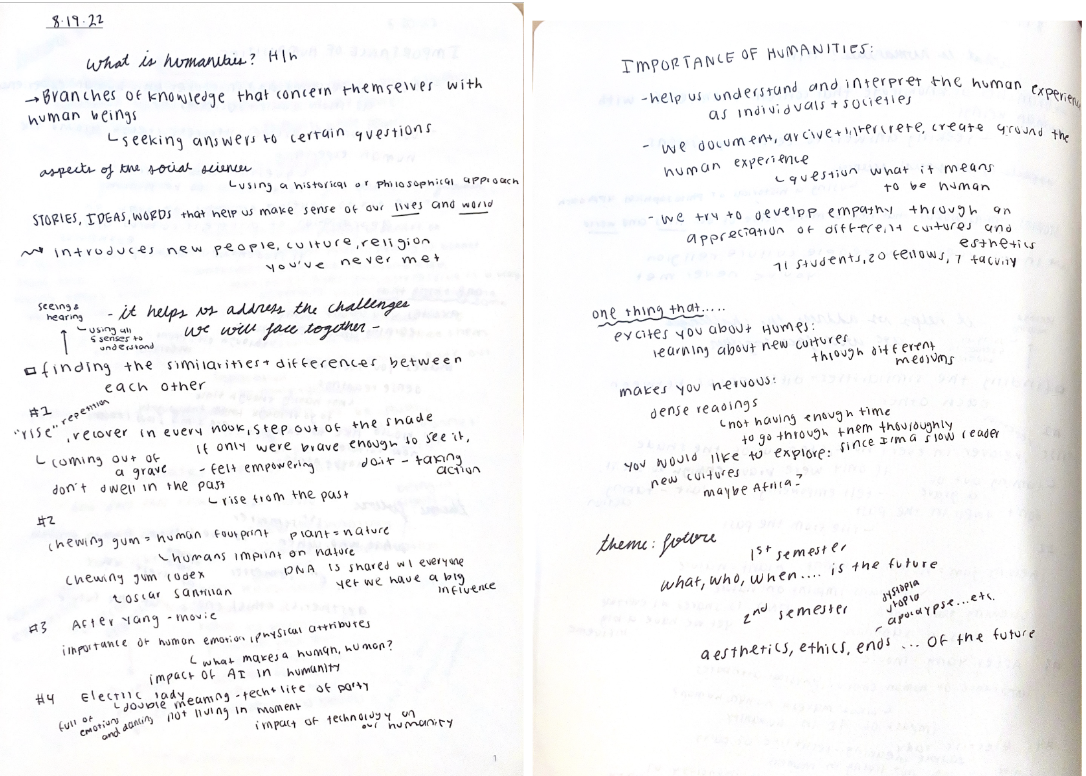
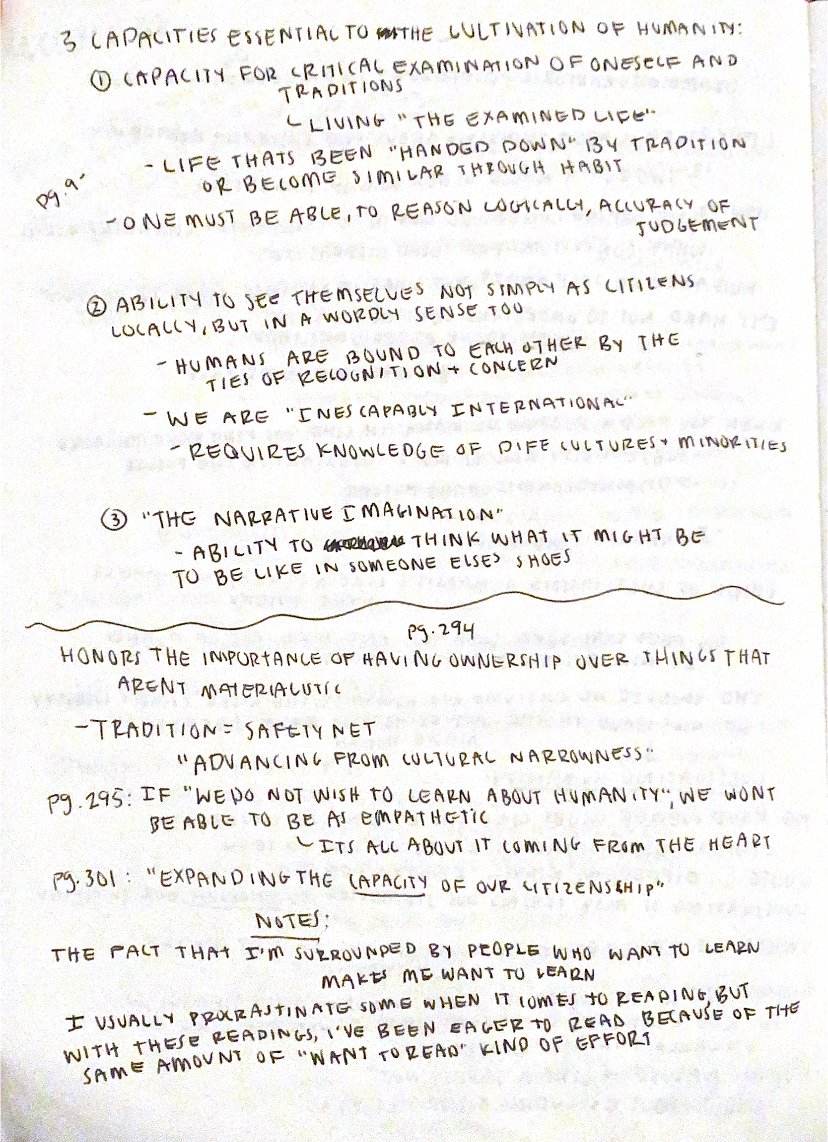
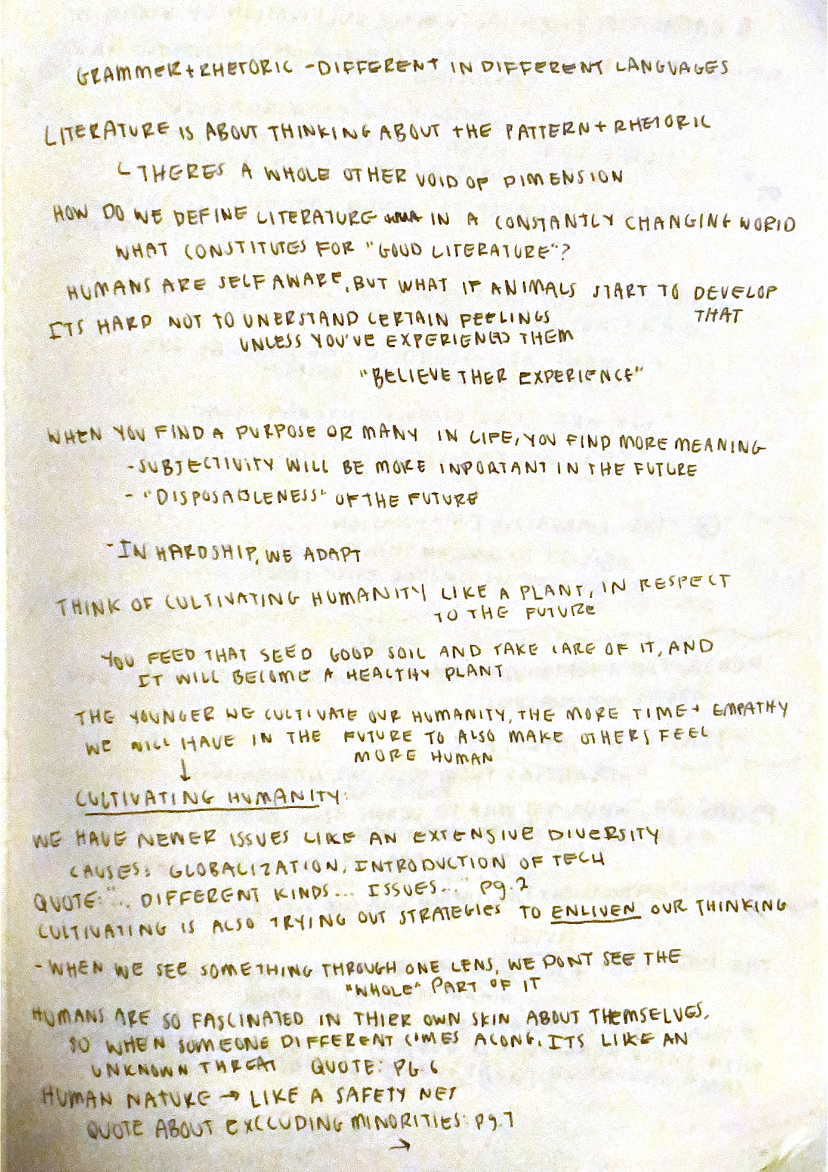
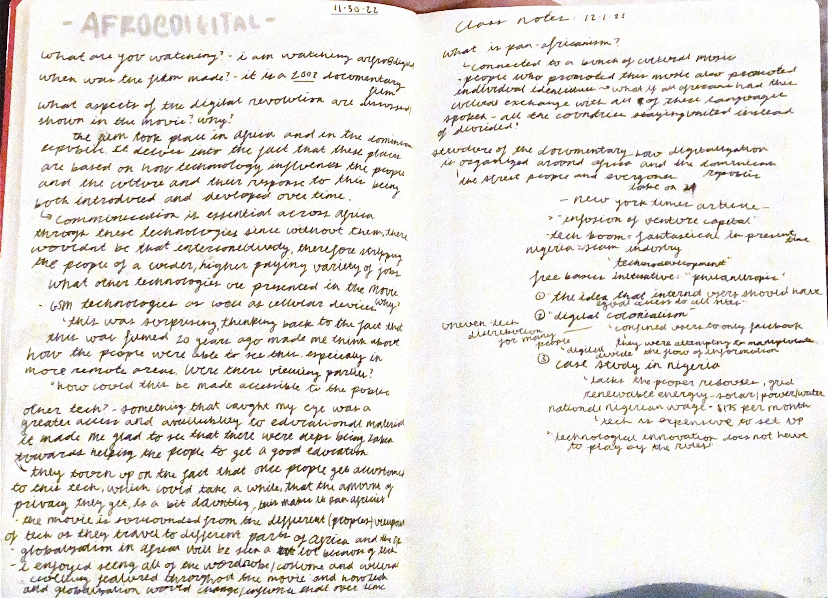
Notes from red notebook from Sapere AudeNotes from red notebook about the cultivation of humanityNotes from red notebook about the cultivation of humanity – continuedNotes from red notebook about the Afro-digital
Humanities
Humanities is the program we are currently in, which allows for students and professors to openly speak their minds over a certain topic. Setting aside one's differences in order to explore a new culture opens up this intellectual discourse where, as a result, one also learns about themselves and what they agree and disagree with. During unit 2, in Boyer’s plenary, we learned about comics, where outside of this class, I wouldn’t have gotten the chance to discover more about them. For example, it’s important to identify whether or not the comic is formal and/or aesthetic or if its text or thematically heavy. In doing so, It helped me to have this information at the back of my head when reading the comic WE3, about animals being weaponized and turned into cyborgs. With this in mind, throughout week 5, especially in plenary, the Humanities course gave us the opportunity to put into discourse Donna Haraway’s “A Cyborg Manifesto” with Grant Morrison and Frank Quietly’s WE3 comic. We used this to talk about the animal, the human, and the future of subjectivity. Talking about the distinctions between cyborgs and humans where the boundary between physical and non-physical is very imprecise for us, allowed the class to comment on this saying that the self is prejudiced inherently and is deeply committed to the notion of identity while the cyborg isn’t. The cyborg, as we all agreed on, isn't trying to find a point of origin, but rather skews origins for a perpetual becoming because it means that the cyborg still won’t have a stable identity. In Sample’s plenary about the Anthropocene and Sublimity, there was plenty of room for the class to share their thoughts about these ideas. We talked about the consequences of this epoch and its effects by terrorizing many people internally and how it would look different based on environmental and societal factors. This week heavily influenced the portfolio's theme of sublimity by providing an academic perspective on the matter. Additionally, it also expanded my perspective and added terms to my vocabulary on how to approach such a sublime topic on a micro level to gain a better understanding of it. In relation to this, Humanities is also about actively questioning and welcoming the opinions of others into one’s head, which allows for an exploration of oneself too. During prof Robb’s plenary on the AI Apocalypse, in learning about his extensive analysis and characterization of it where first macine’s become conscious, then we will upload our minds to a computer, ending with the apocalypse, where we can lo longer understand this advanced technology. This not only allowed for discourse of the possibilities of what is to come in the future, but also presented a new viewpoint in pondering what the future would be like. Similar to AI, in Prof Sample’s plenary during unit 1 on The Technological Imaginary, he presents the idea of the future being here, just unevenly distributed around the world. We can use this idea to expand our thoughts into looking at how technology has fundamentally changed the way we look at our own humanity by, for example, comparing and contrasting western tech versus tech from other parts of the world. From spring semester, as a part of Unit 4: Aesthetics of the Future, Fache in plenary offered her perspective tailored to the Humanities Program on the African Imagination and the importance of oral tradition. Specific to the class, oral tradition, which is produced by within and for the traditional societies and indigenous cultures of Africa contains three levels of orality which includes ordinary communication, rhetorical uses of language, and literary expression. These three levels exist along a continuum with no sharp borders or boundaries. Therefore, the Humanities offers a new perspective of the social significance of orality as it is a living document for patrimony that we cannot capture but is essential to a culture's identity. As a part of sublimity, the way in which we define sublime and landscapes/ cultures that contain so many layers of identity affect the narrative and story we tell ourselves. By adding more perspectives to the table, Humanities helps to highlight the human impact on the world and acts as a diagnostic tool through thoughtful discussion. In Unit 5, Ethics of the future, during Dr. Wills’ plenary, the program was enriched yet again by Natasha Tretheway’s visit to campus for a poetry reading of her book Memorial Drive, where she walks down memory lane, entailing her driving through her life’s timeline as she reflects over her deceased mother’s memories. As a part of the Humanities, a question we ask ourselves often during discussions is about collective memory and how we create and represent it. There is such a sublime amount of memories, some which may never be vocalized, transcribed into writing, or reflected on. There will be half or even more than half of the story that becomes lost in time or stays inside the individual. Lastly, in Unit 6 on the ends of the future, Wills’ and Pyle’s lecture connects into various niche and specific readings that tailor themselves to the Humanities as a branch of the sublimity of the humanities. Specifically, in Lauryn Hills Black Rage, she writes this song based on a poem that goes with the tune of the music. In the music, the lyrics highlight a feeling of comfort that comes with black rage that's comforting. On broader terms, a social death that happens amongst many micro-fields in the humanities theorizes the condition of enslavement in the americas where people are not being accepted as fully human. There are also multiple tenets of social death which includes gratuitous violence where the body is the question, natal alienation, and general/ pervasive dishonor, which includes the encoding and describing blackness as dishonorable. Therefore, the Humanities is defined as an outlet for historical interpretation where unique individuals from various backgrounds and perspectives come together in discourse of other niche perspectives. Engaging in conversation in a place that allows this to pick out parallels and differences between all of the units, in retrospect, is essential to keeping the program abundant in knowledge and giving a voice to the silenced ones.
humanities
The humanities are branches of knowledge that concern themselves with human beings and are seeking answers to certain questions. This has to do with our pursuits, and whether it be individually or on a border level, it’s still vital to gaining a better understanding of how humans express themselves in many ways through different mediums. In order to gain more knowledge about the variety of ways to approach learning about the intricacies of humans, each week, our professors taught us about a variety of topics. In unit 1, during plenary discussing Borges, we also correlated these branches of knowledge with presentism and the way in which time and how we mark different times are different from others. Since most of the humanities functions on making the most use out of time, it’s an endless, inescapable, intrinsic cycle that’s performed appropriately in various branches of knowledge like philosophy, history, culture, language, and the visual and performing arts. In unit 3, during prof Boyer’s plenary, the class talked about the Codice Mendoza, a spatial and temporal book, and how it was meant for the king and other european consumers. This exemplifies the humanities response to globalization and the intertwining of cultures in Aztec land, which was to make an account for Aztec conquests across many villages in central america since we exist in a time that is going to end. Putting this in conversation with the idea of temporal displacement, where one's home and religion preserve our past, prof Wills in her plenary on what religion says about the future of humanities, highlights the phenomenon of millennialism in protestantism. This branch of knowledge as a part of the humanities is with the idea of restorationism and leaping back to the traditions of the catholic church. Including all religions into humanities improves the way in which we find trends throughout these different cultures. Similarly, Prof. Fache in her plenary speaks of the different aesthetics in these branches of knowledge through west african cinema where the narrative structure may be different and we may not be able to appreciate these obscure narratives from other cultures since we aren’t used to seeing them. Using this cinema as a leeway into understanding African culture also helps to define the humanities in that we can study these aspects of multiple human cultures and societies through time in order to give us the tools to navigate the present and have a clearer image of the future. In Unit 4, while talking about cloth politics in Wiemers plenary in relation to the self consciousness category of modernity, we also highlighted the importance of how these cloths are defined and the sublimity of interpretation. Since each specific print has its own meaning, they are defined differently by a colonial officer than the person wearing it. Therefore, fashion is another important outlet that is one of the ties to the humanities in the sense that it allows an individual and society to express themselves in communicating a varying response to and with other people. It marks you in time and stays with the time. When reading Memorial Drive in Unit 5, throughout our plenary and section, we discussed the impactful ways in which our past defines our present and will continue to define our future. The humanities gives us the tools and resources to approach the human and study of various cultures from a more holistic perspective. Utilizing poems as a medium of expression for Natasha Tretheway and interpreting them based on previous knowledge on her unstable childhood, provided an even deeper understanding and added a layer into studying the intricacies of the humanities. When talking about afrofuturism in Unit 6, based on Pyle’s lecture, there are multiple misreadings and interpretations of evidence, which plays a heavy role into how we approach the humanities. It is essential to keep an open mind when encountering various narratives. Specifically, in afro pessimism, one of the main criticisms is that it promotes rage and not hope for being useful on many occasions. Therefore, we should be cognisant of the meaning of words when thinking of the literariness of afro pessimism. In broader terms, the humanities is and will continue to be defined every second by passing time, current events, and people. Most importantly, though, is the narrative we are telling ourselves in the ways in which we define humanities.