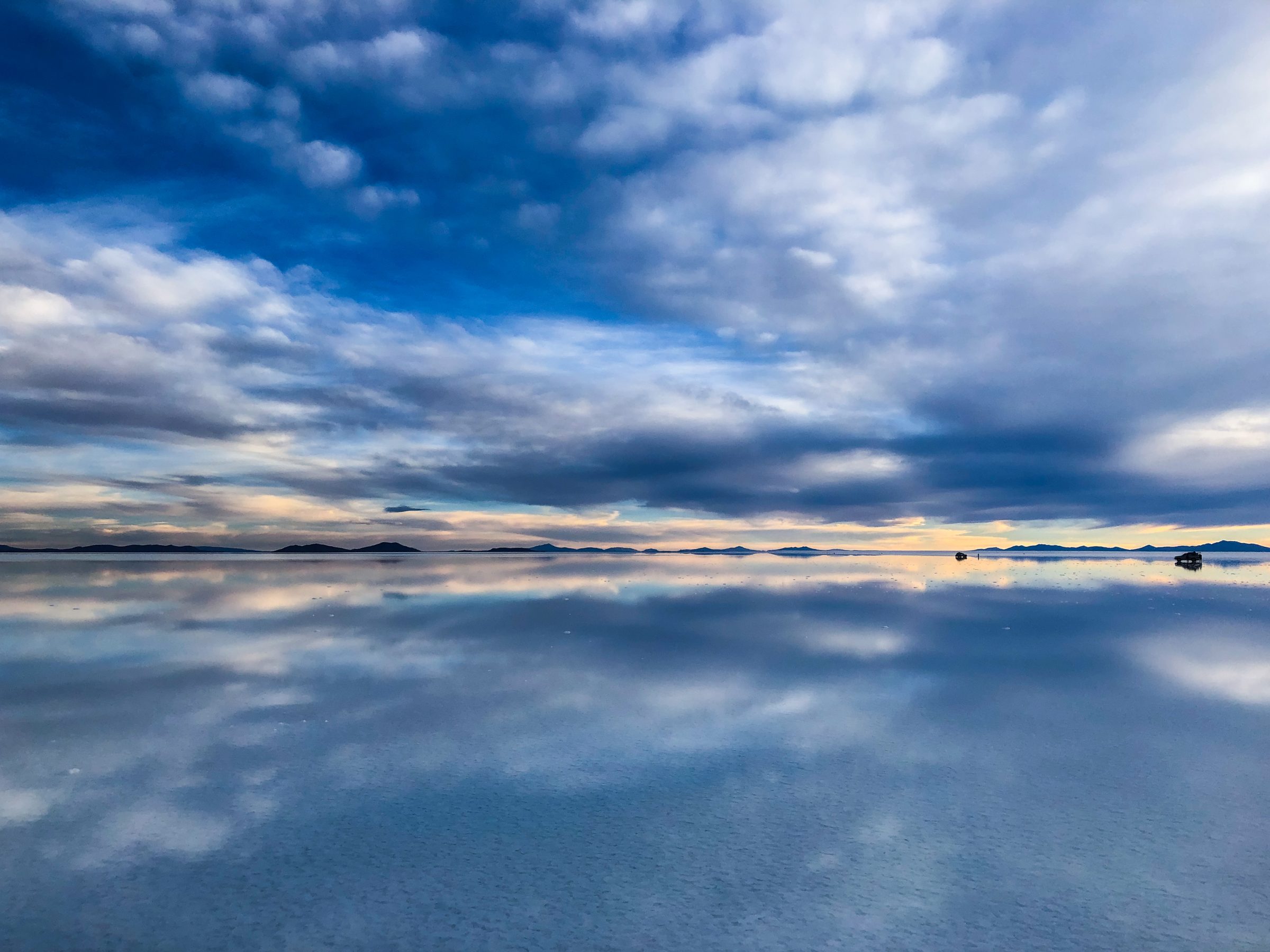
The Future of Sublime Landscapes: Salar de Uyuni, Bolivia
El Salar de Uyuni, located in the altiplano of Bolivia, contains over 12 billion tonnes of salt, making it the largest salt flat in the world currently; it possesses the largest lithium deposit. It is known not only for its incredible beauty and biodiversity but also for its potential economically.[1] When examining a constantly changing landscape, one must also consider the people interacting with it and their qualities. Therefore, in this paper, I will delve into the less-talked-about side of the salt flats and what goes beyond their beauty. I will be analyzing, based on scholarly and artifact research of the matter, how this sublime landscape has, is, and will be defined in the future by local indigenous and exterior communities and how the valuable mining of the natural resource lithium has altered how we understand what drives social change in the area.[2] In addition, I will argue the importance of narrative within society and community and how it influences how individuals view the world and have various perspectives.
Amongst scholars, as the largest lithium deposit in the world, with the ongoing need for it for battery production, being the lightest metal on Earth, lithium has become a demanding valuable commodity for producing phones, cars, and more. The Lithium Triangle, an expanse of the Andes region, the Atacama desert in Chile, and the salt flats of Uyuni in Bolivia, contain high lithium concentrations.[3] The mining process is also extensive, which involves drilling holes in the salt to be pumped to the surface and evaporating in ponds to form the lithium-required resource.[4] Once isolated from its surroundings, since 1976, when the government discovered lithium in its brines, the salt has been used for extracting this resource and research.
According to Maria Sanchez-Lopez, the Salar de Uyuni has been commodified and significantly transformed throughout the past decade.[5] In addition, Lopez and Gooddun et al. explore how its symbolic meaning has changed over time for indigenous communities and how various elements of the flats allow a greater understanding of the socio-environmental change prevalent in this region.[6] The landscape went from an uninhabited expanse to becoming rich in lithium, which is essential to understand how local communities are shaping the salt flat compared to newcomers and industrial mining companies.
At the opening of the lithium mine, a newspaper article in Spanish talked about the construction of the plant in the Salar de Uyuni salt flats in Bolivia.[7] Overall, in five years, it should be able to produce over 350,000 tons of salt yearly. The power player in the market, therefore, is Bolivia, which has close to 42% of the world's lithium. However, concerns about the social and environmental impact remain since the country, although impoverished, is naturally resource-rich. The most significant concern is water, where there is no specific known sum of the underground amount and the amount lithium mining will use.[8]
President Evo Morales is using this new business as an opportunity to industrialize Bolivia's economically benefiting natural resources.[9] Yacimientos de Litio Bolivianos, the company behind the construction of the lithium plants, will also plan to expand even more in the future in taking advantage of the abundance of the resource. This year, Bolivia announced it would partner with a Chinese company to extract it, making Bolivia a significant player in the global market with promises of jobs, money, and economic growth and development.[10] In addition, roughly 60% of the world's lithium is processed in China, making it a powerful source of income for the Bolivian government.[11] Specifically, Audrey Sérandour from la Sorbonne in Paris initially describes the Bolivian government's lack of cooperation with international companies demanding the natural resource and instead making the lithium and salt flats a source of national pride even though the companies in charge of the plants on the ground have been faced with problems of their own.[12] Overall, the source approaches the lithium mining project by connecting with the locals and analyzing how it does so with the territory around the inhabitants.
Boissoneault notes that Uyuni is a source of national pride with untapped wealth that has just been discovered. She argues that it is not the ecological rarity or the tourism revenue but the precious metal that lies below the surface that will promise a flourishing economy within Bolivia. In response to Boissoneault's argument, Anna Hopper states that because Bolivia contains an estimated 5.4 of the total 11 million tons of the mineral in the Salar, Evo Morales promised to nationalize some of the country's lithium.[13] Therefore, he should find the perfect balance between his people's needs and international demand, where 60% of profits must stay in the country. Morales defines the landscape, as Hopper realistically keeps in mind in her article with Bolivia is one of the poorest nations in Latin America, that the flat's large lithium reserves have the potential to revitalize the economy, but nationalization seems unlikely because the country lacks the money to invest in the lithium industry and tech to extract the mineral.[14] Bolivia is a socialist country, so it may have to commit to long-term partnerships with multinational corporations willing to invest.[15] When defining the Salar de Uyuni through an economic lens, Boissoneault remarks that in lithium mining, reaping the rewards of mineral wealth and using these monetary gains to better the lives of impoverished people may potentially destroy the natural ecosystem in the process.
The Aymara people have harvested common table salt for decades as a small-scale process. Their landscape is defined by the knowledge their ancestors have passed down through centuries. The indigenous community in the Salar de Uyuni is made up mainly of Quechua and Aymara people who have lived in the landscape for multiple centuries and, as a result, developed a deep understanding and connection of the land in which, through a reciprocal relationship with the land, use it for grazing alpacas and llamas and extracting the salt. Additionally, they have long used this as a resource where most houses are built of these salt-mined bricks. Therefore, the materiality and the culture that goes with the valuable resource of lithium include human and non-human identities in constant play with each other, giving nature its materiality from the perspective of a human.[16] How indigenous and locals interact and define their previously isolated landscape has changed with the co-production of new social relations amongst exterior countries, especially China, Russia, and the US. As a result, it had become a commodity for them. Its symbolic meanings of the past that have to do with a reciprocal and non-exploitative relationship between the land and people have to be pushed away when claiming their rights and sovereignty. Becoming a resource has also intrinsically added tension within the indigenous community because there is a constant dualism between joining more giant mining corporations to gain income for their families versus taking care of the land as their ancestors did.
Representing the Salt Flats visually, photography, specifically in documentary style, is a powerful artifact that supports how perspective and perception of sublime landscapes play a prominent role in how humans interact with them. Using two artifacts as a new lens for understanding indigenous and local cultures, the documentary Salero[17] takes a rare look into the largest salt flat in the world, Salar de Uyuni, through the eyes of a local Moises Chambi Yucra who is one of the last remaining salt gatherers. Colcani, a town next to the vast expanse of salt, is the only place that mills the salt where the Salero's are the only ones left as the brothers and sisters of the land. For Moises, the Salar shares the land with the people, reflecting and emphasizing the region's folklore. The film talks about how, due to the rapidly disappearing profession of salt mining, the town is no longer about the work of a Salero because the people realized they could earn more money from the rapidly growing tourism. The Quechua people, as a result, want to be in the loop with the modern world, and to make a living, they must submit to tourism since it pays more and move away from the landscape that mattered to their ancestors. In addition, the film continues to talk about the rise of lithium mining in the flats and how the big industrial Bolivian companies coming in are extracting the land from its natural resources. In the past, in Potosí, it was exploited through the extraction of silver for the colonizers, so the locals fear a mass salt extraction that deprives the land of life.[18] The ancestors of the Quechua prioritized protecting the land. However, in a constantly growing world, nothing lasts forever, so the people have to move on, although it pains them since they have worked on the salt flats for many generations exhibiting traditional practices and using less automated machinery.
In giving voices to the locals, many words and phrases need to be included in the translation. Throughout the interview with Moises, some of the subtitles did not directly translate into English since they could not. This impacts what he was trying to vocalize in the film, where, for example, throughout many parts. However, he was trying to talk about his ancestors' relationship with the land; his specific wording describing it could not be translated directly into English.[19]
The documentary portrays the dualism of the effects of this secluded region being thrust into a future where Bolivia embarks on a plan to extract a precious mineral to build an infrastructure to connect it to the modern world.[20] In this sense, many are moving from their dreams of making a higher income into a reality where that is possible through building their lives around tourism and working on the lithium plant to make a living.
In parallel with Salero, Un Hombre que Camina[21] (A Man Walking), filmed in 2011 and completed in 2014, approaches the human definition of this sublime landscape in an art form, where a local indigenous dressed in a Diablo de Tropa symbolizes ferocity and is worn when dancing as a representation of the victory of Good over Evil. The man speaks of the land to be the "Pachamama," the holy, sacred land. For 8 minutes, he carries across the mirror-like salt flats, wading in the water business clothes. This highlights the classism and the impact of more giant corporations on the ecosystem and people where the capitalist and socialist monetary system takes over local land preservation traditions. Even through all the strife, the indigenous man continues to bless the land.[22]
Enrique Ramirez, the director, engages with both politicized and personal recollections, gathering stories and memories to highlight the displacement and loss of the effects of a changing landscape. He uses filmmaking and art to express how society moves through cycles in time where they sometimes move forward and others backward. Un Hombre que Camina evokes a distinct sense of rhythm that is overpowered by a sense of timelessness within the landscape. Overall, this artifact is deeply invested in a loss of regional identity within the local community.
The positive aspects of the relationships between the land and people have been its economic opportunities. Despite the poverty faced by many of the locals, they look for these mining opportunities as a means to gain the necessary money for their survival.[23] The future of indigenous people in the Salar de Uyuni will depend on how higher authorities address land-control challenges.[24] By recognizing and protecting their culture and rights, it is essential to include these communities and the wisdom of the land in decision-making processes on how to adequately and fairly manage its natural resources.
Tourism has played a principal role in adding a new layer and lens to the discourse of how sublime landscapes are defined. From a new and alternate standpoint, the growing demand for tourism in the Salt Flats affects how outsiders perceive and treat it. The Salar de Uyuni has long been a tourist draw and the most visited ecotourism attraction in the country, which becomes an unearthly mirror of the sky.[25] As a hot tourist spot, the flats provide a unique opportunity to experience the awe-inducing sublime landscape. On the one hand, tourism has brought economic opportunities for many locals struggling to stay afloat to make profits from artisanal work and tour services.
On the other hand, because of an influx in tourist traffic, waste management is a significant issue surrounding the salt flats. Many delicate biodiverse ecosystems in and around the flats now experience an additional factor of human-induced environmental instability. This excessive pressure on the ecosystem could have irreplaceable consequences on the environment. Because of new hotels and building construction, the delicate ecosystem has damaged these areas, causing wildlife to be displaced.[26] Therefore, it is crucial to develop sustainable tourism that instills a culture of respect between the visitors and land—implementing strict policies amongst touring companies and reducing waste disposal aids in mitigating and ensuring a multifaceted appreciation and consideration for the flat. How the Salar de Uyuni is defined and utilized by the Bolivian government, local indigenous communities, and outside visitors will continue to differ in the foreseeable future. By intertwining these views together, giving them each a strong voice, and implementing environmental protection and conservation at this unique ecosystem, will ensure a sustainable and equitable future for the Salar and its people.
In contrast, an article written in Spanish in Miami brings into conversation a peaceful approach to imagining the salt flats as an incredible phenomenon. Instead of focusing on the beauty slowly being taken away, it focuses on the flat's beauty in the present. It highlights the salt flats as the "espejo natural del cielo" (Earth's natural mirror) and its expansiveness.[27] In addition, the article can also be seen as an advertisement as a worthwhile tourist attraction as it mentions the impact of visiting in person since photos of the landscape don't do it justice.[28] As a result, going at great lengths to travel to the landscape to see a "la naturaleza [que] es perfecta" (a perfect representation of nature" would be worth it, according to the article. Presenting a point of view such as this article excludes what is really going on in the salt flats, which is lithium mining.
All in all, the modes in which we interact with people differ based on our experiences; therefore, how we define an environment, which in this case would be the Salar de Uyuni, matters based on our perceptions of it and the information we have been fed, if any, about it.
The way in which we define sublime landscapes varies and will change constantly in the future, even, as well. Therefore, the landscape remains haunting and disorienting with an uncertain future.
___________________________________________________________________
Works Cited
“Bolivia and Its Lithium - Can the Gold of the 21st Century Help Lift a Nation out of Poverty?” YouTube, May 25, 2010. https://www.youtube.com/watch?v=hFetoqpgRSU.
“Bolivia’s Dream of a Lithium Future Plays out on High-Altitude Salt Flats.” The Guardian, January 25, 2023. https://www.theguardian.com/world/2023/jan/25/bolivia-lithium-mining-salt-flats.
El-Mundo (2011) Evo Morales: “Se acabó la exportación de litio, queremos un Toyota hecho en Bolivia”. 24 February. http://www.elmundo.es/america/2011/02/25/economia/ 1298591131.html.
Galaz-Mandakovic D (2017) Turismo en Uyuni (Bolivia): Reconversion, migraciones y pau- perizacion comunitaria 1996 –2013. Teorıa y Praxis 23:9–43.
Internet, Unidad Editorial. “Economía: América.” Evo Morales: “Se acabo la exportación de litio, queremos un Toyota hecho en Bolivia” | Economía, February 24, 2011. https://www.elmundo.es/america/2011/02/25/economia/1298591131.html.
Javiera Barandiarán, Highlights. Analysis of ongoing debates about lithium in Chile, and AbstractThe world’s largest deposits of lithium lie in brines found underneath salt flats in the desert between Chile. “Lithium and Development Imaginaries in Chile, Argentina and Bolivia.” World Development, October 4, 2018. https://www.sciencedirect.com/science/article/abs/pii/S0305750X18303516.
Komi, Sanna. “Contested Relations between Resource Extraction and Alternatives to Development : The Case of Lithium Production in Bolivia.” Contested Relations Between Resource Extraction and Alternatives to Development : The Case of Lithium Production in Bolivia, January 1, 1970. https://helda.helsinki.fi/handle/10138/193638.
Las increíbles imágenes del Salar de Uyuni, el desierto de sal más grande del mundo. Spanish ed. Miami: ContentEngine LLC, a Florida limited liability company, 2021.
Pereira, Godofredo Enes, Christina Leigh Geros, and Jon Goodbun. “Take Back the Land.” Architectural design 92, no. 1 (2022): 54–59.
Person, Sinclair M. G. Fabio S. M., and Guerra Castro. “Lithium and Vivir Bien: 6 : Sovereignty and Transition: Fabio S. M.” Taylor & Francis, February 22, 2021. https://www.taylorfrancis.com/chapters/edit/10.4324/9781003147923-6/lithium-vivir-bien-fabio-castro-sinclair-guerra-paulo-lima-filho.
Places, Magic. “El Salar de Uyuni, El Espejo Del Mundo.” iAgua, May 23, 2018. https://www.iagua.es/blogs/magic-places/salar-uyuni-espejo-mundo.
Plunkett, Mike, Andrew Goldman, and Anna Rose Holmer. Salero. New York, NY: Cinema Guild, 2015.
Poveda P (2014) Impacto económico de la industrialización del litio del salar de Uyuni en la región. In R Calla, J C Montenegro, Y Montenegro and P Poveda (eds). Un presente sin futuro: El proyecto de industrialización del litio en Bolivia (pp 125–168). La Paz: CEDLA-Plataforma Energetica.
Pozzo L (2010) Saqueo del litio y del boro potosino: La trágica historia de nuestros minerales. In L Pozzo, J Colque and P Poveda (eds) Analysis del Poder Transnacional Minero en Bolivia: Las minas no son nuestras (pp 6–10). La Paz: CEDLA.
Revette A (2016) This time it’s different: Lithium extraction, cultural politics, and development in Bolivia. Third World Quarterly 38(1):149–168.
Roque, Mario. Bolivia inaugura planta de cloruro de potasio en el salar de Uyuni. Hamburg: dpa Deutsche Presse-Agentur GmbH, 2018.
Sanchez-Lopez, Maria Daniela. “From a White Desert to the Largest World Deposit of Lithium: Symbolic Meanings and Materialities of the Uyuni Salt Flat in Bolivia.” Antipode 51, no. 4 (2019): 1318–1339.
Sérandour, Audrey. “From Natural Resource to Nation Building: Geopolitical Analysis of the Lithium Exploitation Project of Uyuni Salar, in Bolivia.” Annales de géographie 2017, no. 713: 56–81.
Timmo Krüger. “Whose Future Is It Anyway? Struggles for Just Energy Futures.” Futures, August 4, 2022. https://www.sciencedirect.com/science/article/abs/pii/S0016328722001185.
Un Hombre Que Camina. https://kadist.org/work/hombre-camina/.
Wanger, T.C. (2011), The Lithium future—resources, recycling, and the environment. Conservation Letters, 4: 202-206. https://doi.org/10.1111/j.1755-263X.2011.00166.x.
Wright, Lawrence. “Lithium Dreams (lithium Resources of Salar de Uyuni, Bolivia).” The New Yorker 86, no. 5 (2010): 48–48.
[1] “Bolivia’s Dream of a Lithium Future Plays out on High-Altitude Salt Flats.” The Guardian, January 25, 2023.
[2] Galaz-Mandakovic D (2017) Turismo en Uyuni (Bolivia): Reconversion, migraciones y pau- perizacion comunitaria 1996 –2013. Teorıa y Praxis 23:9–43.
[3] “Bolivia and Its Lithium - Can the Gold of the 21st Century Help Lift a Nation out of Poverty?” YouTube, May 25, 2010.
[4] El-Mundo (2011) Evo Morales: “Se acabó la exportación de litio, queremos un Toyota hecho en Bolivia”. 24 February.
[5] Sanchez-Lopez, Maria Daniela. “From a White Desert to the Largest World Deposit of Lithium: Symbolic Meanings and Materialities of the Uyuni Salt Flat in Bolivia.” Antipode 51, no. 4 (2019): 1318–1339.
[6] Javiera Barandiarán, Highlights. Analysis of ongoing debates about lithium in Chile, and Abstract. “Lithium and Development Imaginaries in Chile, Argentina and Bolivia.”
[7] Las increíbles imágenes del Salar de Uyuni, el desierto de sal más grande del mundo. Spanish ed. Miami: ContentEngine LLC, a Florida limited liability company, 2021.
[8] Komi, Sanna. “Contested Relations between Resource Extraction and Alternatives to Development : The Case of Lithium Production in Bolivia.” January 1, 1970.
[9] Internet, Unidad Editorial. “Economía: América.” Evo Morales: “Se acabo la exportación de litio, queremos un Toyota hecho en Bolivia” | Economía, February 24, 2011.
[10] Internet, Unidad Editorial. “Economía: América.” Evo Morales: “Se acabo la exportación de litio, queremos un Toyota hecho en Bolivia” | Economía, February 24, 2011.
[11] Person, Sinclair M. G. Fabio S. M., and Guerra Castro. “Lithium and Vivir Bien: 6 : Sovereignty and Transition: Fabio S. M.” Taylor & Francis, February 22, 2021.
[12] Sérandour, Audrey. “From Natural Resource to Nation Building: Geopolitical Analysis of the Lithium Exploitation Project of Uyuni Salar, in Bolivia.” Annales de géographie 2017, no. 713: 56–81.
[13] Poveda P (2014) Impacto económico de la industrialización del litio del salar de Uyuni en la región. In R Calla, J C Montenegro, Y Montenegro and P Poveda (eds). Un presente sin futuro: El proyecto de industrialización del litio en Bolivia (pp 125–168).
[14] Revette A (2016) This time it’s different: Lithium extraction, cultural politics, and development in Bolivia. Third World Quarterly 38(1):149–168.
[15] Pozzo L (2010) Saqueo del litio y del boro potosino: La trágica historia de nuestros minerales. In L Pozzo, J Colque and P Poveda (eds) Analysis del Poder Transnacional Minero en Bolivia: Las minas no son nuestras (pp 6–10). La Paz: CEDLA.
[16] Wright, Lawrence. “Lithium Dreams (lithium Resources of Salar de Uyuni, Bolivia).” The New Yorker 86, no. 5 (2010): 48–48.
[17] Plunkett, Mike, Andrew Goldman, and Anna Rose Holmer. Salero. New York, NY: Cinema Guild, 2015.
[18] Plunkett, Mike, Andrew Goldman, and Anna Rose Holmer. Salero. New York, NY: Cinema Guild, 2015.
[19] Plunkett, Mike, Andrew Goldman, and Anna Rose Holmer. Salero. New York, NY: Cinema Guild, 2015.
[20] Plunkett, Mike, Andrew Goldman, and Anna Rose Holmer. Salero. New York, NY: Cinema Guild, 2015.
[21] Un Hombre Que Camina. https://kadist.org/work/hombre-camina/.
[22] Wright, Lawrence. “Lithium Dreams (lithium Resources of Salar de Uyuni, Bolivia).” The New Yorker 86, no. 5 (2010): 48–48.
[23] Un Hombre Que Camina. https://kadist.org/work/hombre-camina/.
[24] Timmo Krüger. “Whose Future Is It Anyway? Struggles for Just Energy Futures.” Futures, August 4, 2022.
[25] Galaz-Mandakovic D (2017) Turismo en Uyuni (Bolivia): Reconversion, migraciones y pau- perizacion comunitaria 1996 –2013. Teorıa y Praxis 23:9–43.
[26] Wright, Lawrence. “Lithium Dreams (lithium Resources of Salar de Uyuni, Bolivia).” The New Yorker 86, no. 5 (2010): 48–48.
[27] Places, Magic. “El Salar de Uyuni, El Espejo Del Mundo.” iAgua, May 23, 2018.
[28] Wright, Lawrence. “Lithium Dreams (lithium Resources of Salar de Uyuni, Bolivia).” The New Yorker 86, no. 5 (2010): 48–48.